AI website builder · Small businesses
Aida AI Website Builder
I helped one.com launch an AI website builder in three months, then used customer research to guide what we improved next. My focus was the editor and how small business owners interacted with AI while building their sites.
01 · Context
From drag-and-drop to describing what you want
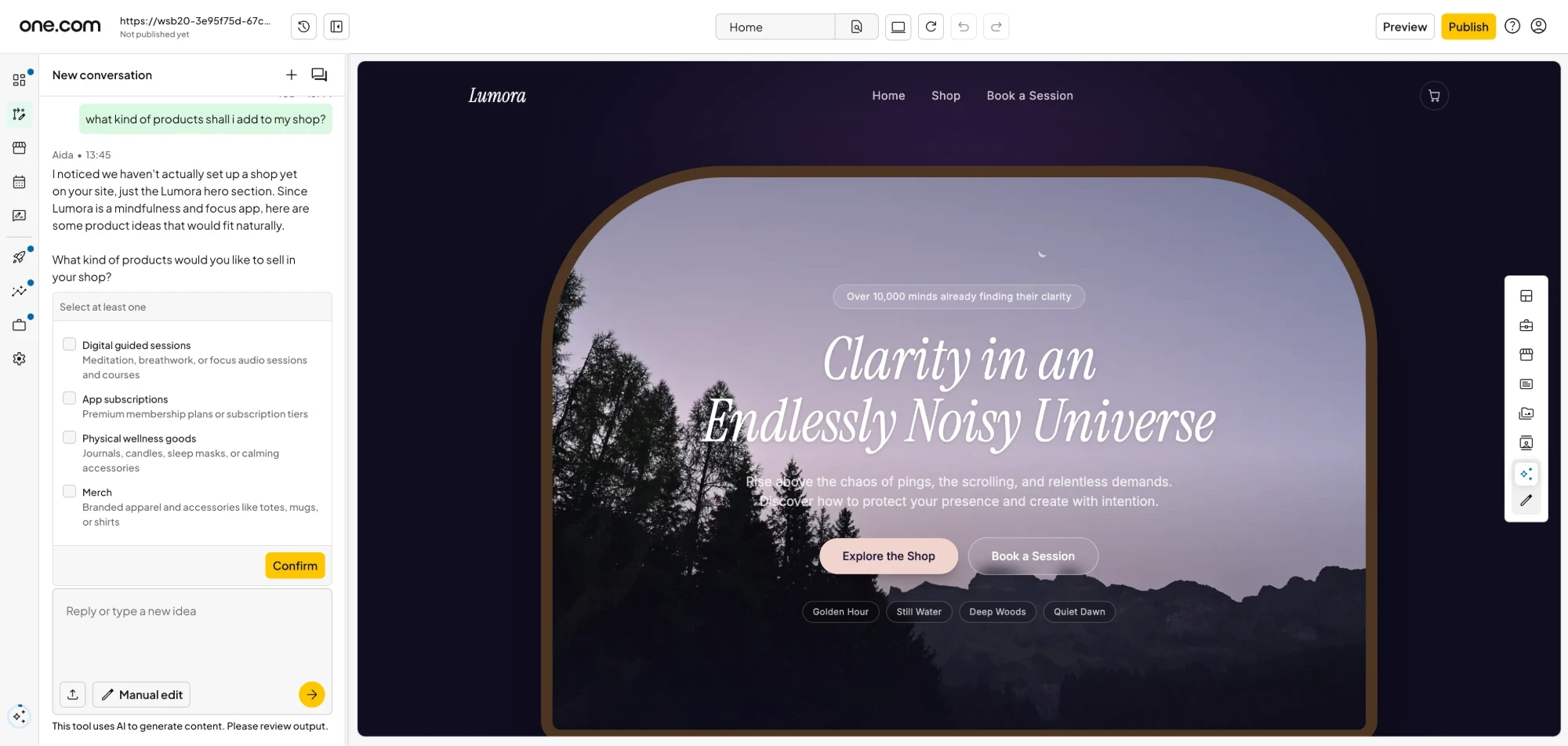
group.one serves more than two million small-business customers across domains, hosting, email, and website tools. At one.com, customers were getting frustrated with the existing drag-and-drop builder. We wanted them to be able to describe the site they needed in everyday language, see it take shape, and publish it within minutes.
That meant rethinking how people would work inside the editor. They could still make changes through the interface, but they could also ask for them in chat. We had to decide which interactions worked better as a conversation, when the AI should ask a follow-up question, and when a simple on-screen control would be faster.
Before · Drag-and-drop builder
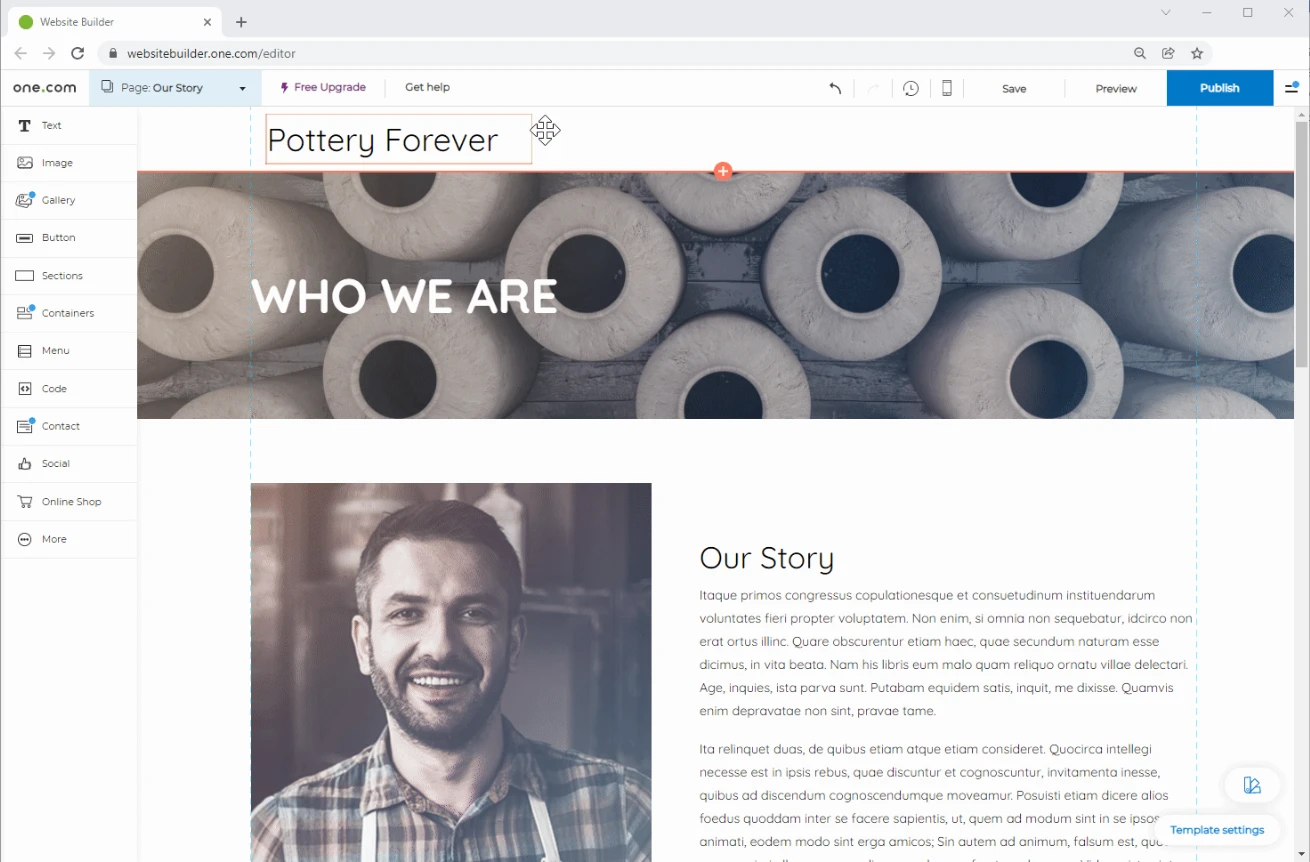
After · Aida AI Website Builder
02 · Launch
Shipping the first version in three months
We focused the first release on the essential path from describing a website to editing and publishing it. Before launch, we tested the experience with friends and family. After three months, we shipped the first version and continued refining it as customers started using it to build real websites.
My focus was the editor itself and the AI interactions inside it: how people asked for changes, how Aida responded, and when a simple on-screen control would be faster than typing a message. Before a conversational designer joined the team, I also helped shape the instructions we gave Aida and the way it replied.
03 · Feedback
Turning customer feedback into product decisions
I worked in a product trio with a product manager and a lead engineer. We combined direct customer interviews, AI-assisted interviews, Aida chat conversations, and product usage data. Direct interviews gave us room to ask follow-up questions and understand what someone was trying to accomplish when they got stuck.
Support tickets were another source of feedback. I set up and launched a weekly report that gave every Aida product trio a Monday overview of the issues customers were contacting support about. The teams could use it to spot recurring friction, decide what needed more investigation, and bring issues into sprint planning.
When a pattern appeared across sources, we asked why it mattered for customers and the business. Then we wrote a hypothesis about what might improve the experience and used impact and effort to prioritize ideas together.
1 · Collect
Many signals, one evidence base
- AI-assisted interviews (added since launch)Open feedback from customers who did and didn’t convert
- Aida conversations (added since launch)What people ask for, expect and struggle with
- Support tickets (added since launch)Recurring friction and unmet needs
- Usage dataWhere behaviour changes or drops off
- Customer interviewsDepth, context and validation
2 · Decide
Evidence into the trio
- SignalsWhat we observe
- InsightsWhy it matters for customers or the business
- HypothesisWe believe doing X for Y will result in Z
- PriorityImpact and effort, decided by the trio
3 · Impact
Better product decisions
- Earlier
- Customer evidence comes in before decisions are locked
- Faster
- Questions get answered without waiting for a new study
- Confidence
- Teams compare evidence instead of opinions
- Focus
- Big and small problems are prioritised together
From isolated studies to a continuous stream of customer evidence. The trio still owns each decision; research improves what goes into it.
04 · Research
What the research uncovered
Customers valued how quickly they could get started and the quality of what Aida created.
64%reported strong satisfaction with the creation experience and output quality
16%said Aida’s results directly influenced their purchase decision
We also found three points where people could get stuck on the way to a finished site.
-
01AI credits could run out mid-build
Some customers used up their AI credits before they finished their website. The first release gave them no way to top up in the builder. I led the UX work on the credit experience, including how people could check their usage and get more credits without leaving the editor. We shipped a usage indicator first. Topping up from the builder is still in progress, and the design will reflect it once it’s possible. The design challenge was to make the limit clear early enough for customers to act on it.
Now: checking credit usage in the editor. Topping up is still in progress. 
Coming soonCurrently in progress. I’ll reveal it once it’s live.
Next: a dedicated AI usage page, showing where credits go and making it easy to top up. -
02Existing customers couldn’t connect a domain they already owned
Some customers already had a domain with us but couldn’t connect it to their Aida site. That left them without a path to publish at the address they wanted. The research surfaced this as a barrier to adoption, and the team resolved the domain connection issue.
-
03ExperimentCustomers were dropping off while the site generated
During onboarding, customers had to wait for the full site to generate before they could see the result. We saw people drop off during that wait, and generating the full site upfront also added cost.
I worked on an experiment that generates a hero section within seconds, giving customers an early glimpse of their design direction. Our hypothesis is that seeing that direction early helps people engage sooner, shortens the time to value, and shows them what they’re waiting for, so they’re more likely to stay through generation. The experiment is still running, so I’ll share what we learn once the results are in.
Coming soonCurrently in progress. I’ll reveal it once it’s live.
The experiment: an early hero preview within seconds, while the rest of the site generates.
05 · Process
How I go from a problem to a design decision
I start with the problem we need to understand, whether it comes from customer research, a stakeholder request, or a signal like low conversion. I look at the data to see where the friction occurs and talk to customers to understand why. If the evidence is incomplete, I document what we’re assuming and write a hypothesis we can test. I agree on the baseline, target, and success metric with the team so we can come back after release and compare the results with what we expected.
I bring product, engineering, and other stakeholders in early. I show the directions we could take, explain the trade-offs, and make a recommendation. At one.com, I’ve used code prototypes to make ideas tangible early, especially when the interaction is easier to try than to explain. Once we’ve chosen a direction, I use Figma to work through the design details where it helps. I document the decision and the reasoning so the team can pick up the thread when we review what shipped.
06 · Reflection
It was never really about the website builder
Launching Aida showed us that getting a website online takes more than a good first draft. People needed to know how many credits they had left, see something while their site was being built, and publish to a domain they already owned. Staying close to customer feedback helped us decide what to fix first.
But the biggest lesson wasn’t about features. Our customers don’t care about AI website builders. They care about their business. They’re hair salon owners, plumbers and consultants who spend their days out doing the work, not sitting behind a screen building a website.
For them, Aida is a means to an end. Keeping that in mind shaped every decision we made: take the effort out of getting online, so they can get back to what they love doing.
07 · What’s next
Agents that help you run your business
I’m currently working on bringing business agents into Aida. The idea is to support small business owners beyond their website, for example by keeping an eye on what competitors are doing.
Instead of having to search for that information themselves, customers get the signals that matter to their business from Aida, along with clear next steps they can act on.